top of page

Heegon Kim

ALZHEIMER'S DISEASE
Renatus goes beyond amyloid by targeting cholesterol dysregulation upstream of neuroinflammation, myelin dysfunction, and neuronal injury.
Alzheimer's disease: Biology and Unmet Need
Alzheimer’s disease is driven by multiple interconnected pathological processes, including amyloid-β accumulation, tau pathology, neuroinflammation, and progressive neuronal dysfunction. APOE4, the strongest genetic risk factor for late-onset Alzheimer’s disease, places lipid and cholesterol biology at the center of disease susceptibility. Altered APOE4-mediated lipid transport and cholesterol homeostasis have been linked to impaired amyloid clearance, tau-associated neurodegeneration, microglial dysfunction and inflammation, and disrupted myelination across multiple brain cell types. Because cholesterol dysregulation sits upstream of and intersects with multiple components of Alzheimer’s disease biology, restoring brain cholesterol homeostasis represents a compelling therapeutic opportunity beyond amyloid alone.

Targeting Cholesterol at the Root of Alzheimer’s Pathology
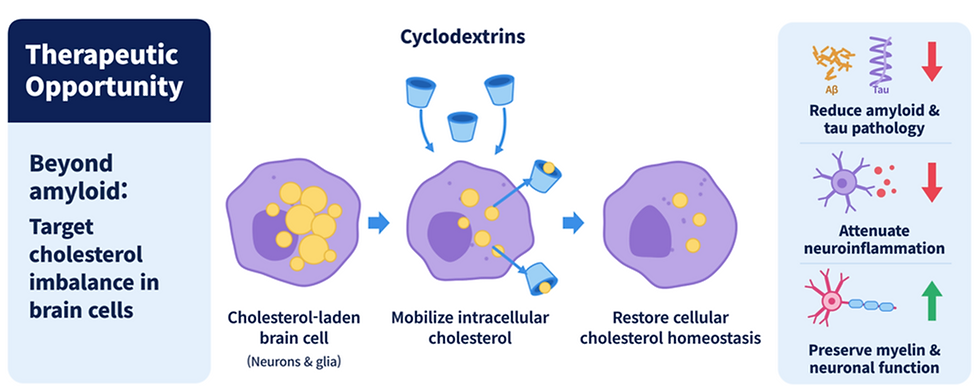
Renatus is developing cyclodextrin-based cholesterol modulators designed to restore intracellular cholesterol homeostasis in the brain. By binding and mobilizing pathologically accumulated cholesterol, cyclodextrins may improve lysosomal cholesterol trafficking, facilitate cholesterol redistribution and efflux, and reduce lipid stress across vulnerable brain cell types. Because cholesterol dysregulation intersects with multiple components of Alzheimer’s disease biology—including amyloid and tau pathology, microglial dysfunction and neuroinflammation, and impaired myelin homeostasis—restoring cholesterol balance has the potential to influence several downstream disease pathways simultaneously rather than targeting a single pathological protein. This upstream, multi-pathway mechanism provides the rationale for developing cholesterol modulation as a potential disease-modifying approach to Alzheimer’s disease.
bottom of page